|
Perfect Wedding
|
|
|
ment
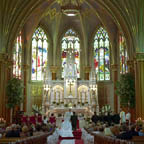 |
Here's how it goes at a traditional Christian wedding: the groom's mother is seated first, then the bride's mother. The bride's mother should be the last person to sit down. (Late arrivals should wait at the back for an opportune moment to slip quietly, unescorted, into pews at the back). The beginning of the processional music, which starts after the bride's mother is seated and the bridal party is assembled and ready, is the cue for the clergyman, groom, and best man to enter the sanctuary.
Normally, the groom's father goes up the aisle with his wife, tagging along behind her and the usher. Alternatively, they could walk up the aisle together, perhaps led by the usher. |
|
You are free to have a ceremony as elaborate and traditional as you want, just as you would be if you were planning a garden wedding or home wedding. Take care to arrange the chairs to form an aisle and still give everyone enough room to sit comfortably and be able to see you and your groom during the ceremony. Leave enough room between each row of chairs so that guests can file into and out of the "pews" easily. Keep in mind that you are not obliged to stick to tradition. Consider taking advantage of your location to try something a little more personal or intimate. For instance, have a traditional ceremony, but instead of having all your guests in rows of chairs, arrange the chairs in semi-circles; or, if the ceremony will be brief, have all your guests stand, surrounding you, the groom, and your ceremony officiator.
In the past, most people did assume that, given a choice of churches, it was likely that the ceremony would be held at the bride's church. A more modern take on this subject would be that the choice of church reflects the decision of the bride and groom and their good relationship with the officiator. The Christian wedding could be celebrated without a mass or with a mass. When the mass is held the procedure of marriage is as follows. Throughout the Mass, take your cues from those around you. The priest will also give instructions. There will be readings and prayers. At times, you will be required to stand. Sometimes, there may be kneeling, but non-Catholic guests can just sit quietly while others kneel. When the congregation is invited to participate in the recitation out loud of the Lord's Prayer, Protestants should be aware that Roman Catholics omit the final few lines: "For Thine is the kingdom, the power and the glory, forever and ever." During the wedding ceremony, vows and rings are exchanged. Just before Communion is served, there will be the "sign of peace": the priest might say, "Let us offer each other a sign of peace," and that is an indication for everyone to turn to their neighbors, shake their hands, and say, "Peace be with you" or some other friendly greeting. Sometimes, relatives or very close friends will hug and a mother may kiss her child at this point. The elements of a wedding ceremony are somewhat universal although they may be embellished and their chronology be modified from ceremony to ceremony. Here are some of the major elements: 1) The Greeting 2) The Declaration of Intentions (Wedding Vows) 3) The Exchange of Ring 4) Blessings and Readings, and 5) The Pronouncement |
|